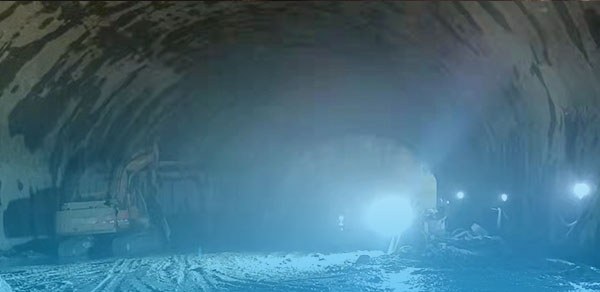
Typical Tunnel Leakage
- Cracks and construction joints in the secondary lining with dripping or running water;
- Failure of lining waterstops and waterproof membranes between the primary and secondary linings;
- Leakage at cross-passages, crosscuts, equipment niches, cable trenches and invert connections;
- Water inflow through the primary lining in fault zones, fractured rock and clay-bearing ground;
- Blocked or misconnected drainage systems that force groundwater behind the lining.
Primary and Secondary Lining Grouting
For the primary (initial) lining, dual-component injection is applied to consolidate fractured rock and clay-bearing ground and to reduce inflow before the secondary lining is placed. AS grout injected as a two-component system both stabilizes the ground and seals water channels, and it can be combined with polyurethane foam, acrylate gels, bentonite grout and other materials to match the ground conditions.
For the secondary lining, gushing defects are sealed with dual-component quick-setting grouts, while damp and weeping cracks may be treated with a single component. Static cracks are injected with high-strength grout or epoxy resin; moving cracks are treated with flexible, toughened epoxy that follows crack-width changes caused by temperature and traffic loads.
Direct Water-Stopping with Fast-Curing Epoxy
Traditional polyurethane injection often stops water initially but re-leaks within months because its bond to concrete is weak and it cannot strengthen the structure. Our fast-curing epoxy grout is designed to be injected directly against low-pressure flowing water: it resists washout, sets within a controlled time and bonds strongly to the crack faces, sealing and strengthening in one operation. Carefully balanced cure speed prevents both line blockage and premature washout.
Drainage and Joint Treatment
Lasting tunnel waterproofing requires the drainage system to function: we inspect and restore weep holes and drainage pipes so groundwater is discharged in a controlled manner instead of building pressure behind the lining. Deformation joints and failed waterstops are routed, fitted with packers, injected with flexible grout and protected with durable surface strips. In cold-region tunnels the repaired joints and linings resist the large seasonal crack-width movements that defeat rigid materials.