Where Garages Leak
- Floor-slab cracks and construction joints where groundwater enters from below;
- Ceiling slab cracks that drip water onto parked vehicles on the level below;
- Expansion and control joints that move with temperature and vehicle loading;
- Column bases, wall-floor junctions and pile-head connections;
- Pipe and conduit penetrations, drainage channels and sump pits.
Repair Methods
Active leaks in slabs and walls are routed into grooves and stopped with quick-setting plugging compound, after which the cracks are pressure-injected with AS grout, high-strength specialty grout or epoxy resin depending on movement and water pressure. Weeping surfaces are treated with cementitious capillary crystalline coating or DPS agent, which seal the concrete internally and resist chloride from de-icing salts.
Expansion joints receive flexible injection plus a traffic-grade surface sealant and, where movement is large, an elastomeric joint system capable of withstanding repeated wheel loads. Repaired driving surfaces are finished with abrasion-resistant mortar that can be opened to traffic quickly.
Ceiling and Negative-Side Work
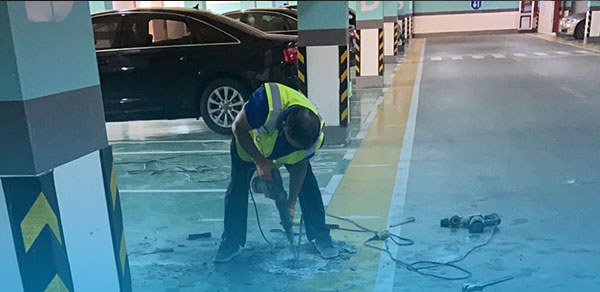
Most garage repairs are executed from the inside without excavation. Ceiling injections are carefully controlled: drill depth is limited to the leveling course so the original membrane is not punctured, and injection pressure is managed to avoid over-packing. Damaged finishes and hollow plaster are removed and replaced before the waterproofing layer is restored.
Durability Considerations
Garage waterproofing must resist not only groundwater but also carbon dioxide, oil, road salts and impact. Our epoxy and crystalline systems increase surface hardness and reduce dusting, while flexible joint details accommodate slab shortening and thermal movement. The combination provides a dry, cleanable structure with low maintenance over the service life of the garage.