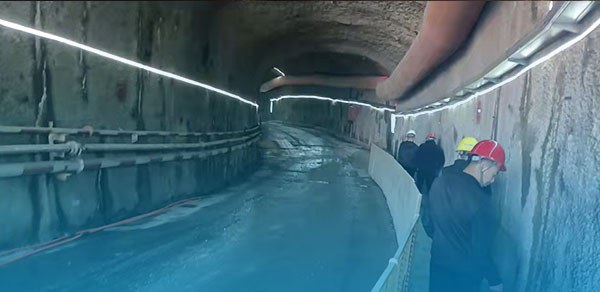
Key Defects in Metro Structures
- Leakage at shield segment circumferential and longitudinal joints, including offset and opened joints;
- Dripping from segment bolt holes, grout holes and lifting sockets;
- Deformation and construction joints in stations, cross-passages and entrances;
- Segment cracks and spalling caused by assembly forces, settlement or loading;
- Large damp zones behind station wall and ceiling finishes.
Shield Segment Repair
Segment-joint sealing is performed from the intrados (inner face): the joint is traced, leak points are routed and plugged with rapid-setting compound, and flexible chemical grout is injected through packers to reach the joint depth. Because segment joints move under train loads, temperature and ground movement, the injected material must remain elastic; rigid cement-only grouts would crack and re-leak.
Bolt and grout holes are fitted with sealant or injected individually, and cracked segments are bonded with low-viscosity epoxy injection that restores the load path without adding section. Corrosion protection is maintained throughout, and finishes are restored to match the original surface.
Stations & Cut-and-Cover Structures
Stations typically leak at construction joints between slabs and walls, at deformation joints and around pipe and cable penetrations. We stop active leaks with quick-setting inorganic plugging material, inject cracks with AS grout or specialty epoxy, and apply cementitious capillary crystalline coating over the negative face for long-term protection. Failed buried waterstops are replaced in function by injected flexible waterstops and surface sealing systems.
Materials Policy for Transit
Many metro authorities restrict polyurethane because of weak bonding, re-leakage and fumes. Our metro programs emphasize low-odor, environmentally friendly modified epoxy systems, inorganic AS and high-strength grouts, and crystalline cementitious materials. These combine water stopping with structural strengthening, low emission levels and durable bonding — the same materials that protect segment linings across the Chinese high-speed rail and metro network.